Today was the first day we tried to get stuck into editing, Melissa taking charge as editor. Of course we experienced a few problems, it's inevitable...
a bunch of our clips got deleted! apparently there wasn't enough disk space on the computer?
just when you thought macs could never let you down.
Sure enough we sorted out the issue by deleting some un-needed documents.
Because of this Melissa got delayed in the editing, and only really managed to do the majority of our dummy run -rehearsal.
Hopefully we can get a load of printscreens up as evidence to show the techniques used ect.
I'll post again when we actually get to editing our final piece.
The purpose of this assessment is to look back and refelct upon all the work we've completed as a group so far, how well we've worked together and what things have been sucessful and what have not... I think something we're quite efficient at is management and organisation and we regularly got together to allocate tasks and brief each other on our progress, however looking at our blogs they all seem very indivdual and singular to that person. As a group we need to focus on linking all our blogs together to remain unite. If we fail to post these links, certain tasks we have actually done as a group will not be shown.
Sections highlighted green are what I believe we have complete during the filming, ad what I think is already located on my blog. Yellow is in the progress of, Red is yet to do.
VIDEO This is the specification for - Level 4 48–60 marks A*/A High B I am aiming high as I want to achieve and do well, so I will try and meet all the criteria. There is evidence of excellence in the creative use of most of the following technical skills:
-holding a shot steady, where appropriate;
-framing a shot, including and excluding elements as appropriate;
-using a variety of shot distances as appropriate;
-shooting material appropriate to the task set;
-selecting mise-en-scène including colour, figure, lighting, objects and setting;
-editing so that meaning is apparent to the viewer;
-using varied shot transitions and other effects selectively and appropriately for the task set;
-using sound with images and editing appropriately for the task set;
-using titles appropriately.
Marking Criteria for the presentation of the RESEARCH AND PLANNING, specification for - Level 4 16–20 marks A*/A High B There is excellent research into similar products and a potential target audience.
There is excellent organisation of actors, locations, costumes or props.
There is excellent work on shotlists, layouts, drafting, scripting or storyboarding.
There is an excellent level of care in the presentation of the research and planning
I did a small experiment on lighting, as a cinematographer this is a key part of my role along with melissa who's also in charge of lighting, I want to ensure as a group we achieve the most effective results.
Ignoring the poor quality photograph and focusing on the effect of the lighting it is clear that lighting shining in from above makes the character seem in a chilling, frightening scenario.
This image of the light gleaming in from the right is rather strong, one side of his face being completely disguises one side of his face. When I look at this photograph I get the impression that he has two personalities to him, one good, one bad. I think this effect is useful if you want to reveal some of the character to the audience, show half of their expression, yet it's as thought the character will always have something to hide until his face is uncovered.
This straight on beam of light, hitting his face directly reveals everything, the characters emotions, it's impossible to hide. I think this technique should be used when showing a characters vulnerability, as they are completely exposed.
This experiment has aided me in realising the correct lighting techniques for differing situations, and which one is the correct one to use to express a particular feeling or mood.
I thought looking into models and designers of the 1940/50's would help me gain an understanding of the style at the time, and as a stylist I intend to convey these times accurately with a modern twist. Carmen Dell'Orifice This particular photograph was my inspiration behind the coffee house scene.
The model just seems so delicate, this is emphasised by the pouring of the tea, the china - it's all very ethereal. I love the strong contrast and pale skin, it seemed a classic feature of a femme fatale. This is why I specifically try to use an actor with this look. This is the perfect picture to represent the character of a femme fatale; mysterious and seductive. The clothing she's in is extremely melodramatic, however this was traditional of noir films. I want to bring across this exaggerated style, however it will be toned down and modernised, although the dramatic make-up will remain the same -Combined with the women's facial expression in this photograph it makes the perfect captivating look.
Lisa Fonssagrives I'm going to experiment with unnatural lighting as I would love to achieve a emphasised cheek as you can see on this photo. It makes the women look more appealing, and as I said for the image above I think a femme fatales facial expression is most important to represent her seductive character.
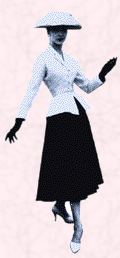
This photograph shows the change in womens fashion which Dior introduced - the cinched waist - flattering style. It's over the top, extravagant and appears alluring. These all being traits of a femme fatale.
Dior's New Look 1947 - A Post War Turning Point in Fashion History
In 1947 Christian Dior presented a fashion look with a fitted jacket with a nipped in waist and full calf length skirt. It was a dramatic change from wartime austerity styles. Femme Fatales clearly took advantage of this enticing style, they could now look feminine and desirable. Evening versions of the New Look were very glamorous and consisted of strapless boned tops with full skirts and were ultra feminine.Women usually wore just underwear beneath the buttoned up jacket, or filled in the neckline with a satin foulard head scarf, dickey or bib. All women were embracing this revolutionary style, they no longer had to conform to a military uniform and for once could radiate elegance. New Look and new approach to fashion was a major post war turning point in Fashion History.
I understand how simply costumes can define the role of our characters, this is why I wanted to research into this eras style. I can now, to a degree, dress our actor and actress in the traditional fashion.
I have came to the conclusion that even though we initially decided to stick the the conventions of Film Noir through the styling, we realised realistically with funding it was nearly impossible. Despite this I believe with the resources we have we can still assemble a look resembling the 1940s, late 1950s. With our chosen femme fatale I have ran through some specific outfits with her and I think I may have found the perfect one!
I have chosen not black, but a still dark coloured floaty dress as it looked perfect with the fur coat we did indeed manage to get hold of. I've paired this with a opaque pair of black tights and some vintage brown loafers - as you can see this is where we have included a modern twist. But of course this is acceptable, as we originally decided our OTS wasin the style of neo-noir. However I think my styling of the hair and make-up will bring it back into the reality of the film noir era, as my group member Ellen Lowe said in her costume ideas 'Make-up will be based around the classic red lip and smokey eyes' We've tested thick layers of eyeliner which appeared to represent the look we were going for, as long as it still remained classy, along with a red lipstick, although we also tried a dark plum colour which looked just as suitable.
This planning was beneficial as it has allowed us more time on the day - we'll be prepared. We can finally put all our practiced, developed ideas into action. The key was organization.
Collaboration of pictures I gained inspiration from; I added a modern twist to the style of our femme fatale, images like this have inspired me. I particularly love her hair, and the signature curved fringe.
This title is equivalent to director of photography DP. This role is designated to the chief of camera and lighting, and they are responsible for the artistic and technical decisions involving the overall image - in this case the image of the scene, however this is where it relates to photography, as my role will be deciding what makes the most excellent image, as though it was still. Considerations:
Camera technique Creativity Composition
Lighting
Centre of interest
A cinematographer is an expert in both the technical and artistic capabilities of a movie camera. I will work closely with the director during shooting in order to properly frame each shot according to the script and the director's personal vision. As well as this I will also be working closely with the camera operator CO (ellen) to capture the best image through the angels and shots controlled by the CO. However there is a clear difference between our roles -the director will often consult the DP for factors such as lighting and filtration whereas they will consult the operator for framing and lens choices. Although in order to achieve the best framing the CO will most likely still consult me, as I would also consult her for particular issues eg. lighting. The director will typically convey to the cinematographer what they want from a scene visually, and allow the cinematographer freedom in achieving that effect, however in some instances the director will allow the DP absolute independence, or even none - going as far as to specify aperture and shutter angle.
I believe I carry enough previous experience- 2 years media GCSE to fulfil these roles. I think I have a keen eye of basically what looks good and what doesn't, which is an explanation of why I would be designated both of these roles. I will closely work with my group, and take on board everyones vision for the final result in particular the directors to create the highest quality OTS. I do think I'm capable of performing the two vital functions of a DP, the technical aspect as well as the artistic aesthetics to support the director's vision of the story being told.
Great Cinematographer; Charles Rosher
Charles Rosher was a two-time Academy Award-winning cinematographer who worked from the early days of silent films through the 1950s. Born in London, he was the first cinematographer to receive an Academy Award, along with 1929 co-winner Karl Struss. Rosher studied photography in his youth but earned a reputation early as a newsreel cameraman. He later moved to the United States in 1909 and found work for David Horsley working in his production company, this made Rosher the first full-time cameraman in Hollywood. In the 1920s he was one of the most sought-after cinematographers in Hollywood, and a personal favorite of stars such as Mary Pickford. His work with Karl Struss on F.W. Murnau’s 1927 film Sunrise is viewed as a milestone in cinematography, revolutionary;
Notable films: Sunrise (1927), The Affairs of Cellini (1934), Little Lord Fauntleroy (1936), The Yearling (1946), Annie Get Your Gun (1950), Show Boat (1951)
Stylist: I don't think I'll find this role as challenging as the cinematographer as it's something that comes very natural to me, however I do think both roles are closely linked, and believe I'm the correct person to be chosen for them. As I said I have a keen eye of basically what looks good. My job is to collaborate an outfit for both characters which is suitable for the performance, era and character. A wardrobe stylist is distinct from an image consultant or a colour consultant, I will be making the decisions for both of these subjects which I find incredibly exciting!
Our Femme Fatale
This is a modern take on a classic femme fatale, photographed by by the talented Paolo Toversi. A collection of these femme fatale style photographs were featured in Vogue.
As you can see the style is supposed to be highly seductive, the look often includes -especially from these modern photographs - lingerie in order to appear alluring. Her clothes are typically black or fiery red and when she sits her slinky ankle length gown parts seductively revealing fabulous black stockinged legs.Femme Fatales are seductive, mysterious and tough. But don’t mess with their affections or you might get a bullet through the heart.
On the mean streets of Chicago or New York you’ll find her clothed in a long trench or fur coat which revels floating, figure-hugging gowns with gloves above the elbow, stockings, high heels, dark lips and smoky eyes. This is conventional at its best. We obviously cannot, and don't particularly want to style our femme fatale this way, so we're going for a much more refined, concealed outfit. Conforming to many conventions still; fur coat, floating dress, dark eyes and lips ect. She is a siren and a seducer, however also has this hidden vulnerability that females can relate to.
Our anti-heroHe will be wearing rugged casual clothing such as; jeans, denim or black, a white vest smeared with oil (he's a working class mechanic). Accompanied with messy, dishevelled hair, and oil marks on his face. It's a simplistic look, showing his lack of money for any extravagant clothing. Men in the audience will not be threatened by him and they may even feel as though they have a bond with him - example of how our OTS appeals the male gender.
This is an unexpected picture taken of me and melissa blogging - all thanks to our media teacher - We were looking into our roles in preparation for when we went out to film! this research was essential as we wanted to be fully aware of what was expected from us on the day. I was therefore researching into a cinematographer. I now have wider knowledge of this role, and you will see my post about it above!