Two members of my group, Kieron and Melissa went to our initial decision of location to show it's
aesthetics and whether it is suitable or not. We were so glad we did this filming and the extensive check around the location as we actually came to find that it was not as appropriate as we firstly assumed. This old street has been greatly modernised to an extreme where we realised it was most likely not even possible to do our recording here.. contemporary cafes and the arts college were what damaged the mise-en-scene. Although the area near the arts college and Saint Georges Street ect. is the location included in our concept board and where we explained to our media class we were going to film, we've now uncovered that this is in fact not appropiate. It was disappointing, as what attracted us to this location were the dark, chilling archways/ alleyways which were aged and suitable for the era of the film, as well as creating excellent framing and mysterious lighting.
As you can see Kieron and Melissa later moved onto another location, Elm Hill - a extremely known place, featured in blockbusters such as Stardust. They simply followed a road called Prince street which lead them here. We had already discussed this location and it had also been mention within our media class - and we knew it would create the correct mise-en-scene, and were also hoping it would have enclosed areas where we could gain that dim, gloomy lighting. We wanted this as it would aid us in creating a concealed ambience. After inspecting this area we discover it was actually perfect!
Luckily it hadn't been particularly modernised, and everything still appeared authentic. It also included a coffee house, in an old thatched roof house, this was valuable to us as there's a scene in our filming where our femme fatale were enjoying a beverage. Obviously we had to go and investigate this area too so it would continiue with the correct vibe and aesthetics we intended.
Overall this location looks very promising!
Friday, 26 November 2010


Thursday, 25 November 2010
TODAYS LESSON, RECORDED PRESENTING
VIDEO PROJECT PRESENTATION 1 from fLIX.TV on Vimeo.
Fair to say it didn't go so well.
Fair to say we've established I'm a terrible group speaker.
I may have rambled, not looked at the audience or camera and generally done a rubbish job, but it's the concept that counts right? To be completely honest I thought my prezi was detailed and provided a lot of useful information about our project, I probably just didn't express that particularly well...
Definitely hoping the next presentation goes better..I wouldn't count on it.
Anyway, today was in fact extremely successful.. in a way, as we received lots of useful feedback, some positive, some critical but thats exactly what we hoped for!
The rest of our class suggested that perhaps we weren't making the best choice with our setting idea, suggesting that it will be busy and the old fashion - film noir setting would be ruined. We will without a doubt take this on board, one of our solutions was to go early morning when it was quiet - we thought this would also be nice lighting maybe making it seem late evening which is was we initially wanted. They also suggested that our scenes atmosphere would be ruined by modern shop displays - our answer to this was to try and work our camera angels so these aren't visible, although we are quite confident that our location doesn't contain many modern stores.
We also gave a brief overview of our plot and narrative, in which we explained how we would break and follow some conventions to follow a more modern direction, such as experimental camera angels. We will follow out some more research to discover whether these decisions appeal to our target audience. After watching other groups presentations it was clear our group was full of some really brilliant ideas! I offered positive feedback, and also asked insightful questions, for instance I was interested in ways other groups planned to follow or break conventions, a couple of their ideas were to alter the colouring - changing the traditional black and white - eg. change saturation. Some groups were extreme on breaking conventions, opting for a neo-noir OTS, this is a contrast to my groups subtle way of breaking them. We're in favour of our own subtleness, as we're fond of traditional film noir and would quite like to follow conventions, in particular the black and white high contrast, dim and mysterious lighting,

This particular photograph from;
GenaroFlacoArroyo,
a cinematographer provides me with much inspiration as how we want the colours of our film opening to look, it's an atmospheric control of lighting which can in turn control how the audience feels.
aswell as these conventions we will also include a romantic/criminal story line which involves an anti-hero and femme fatale.
Wednesday, 24 November 2010
STORYBOARD..KIND OF.
We got told today to create a storyboard however in a different form I was familiar with, not to say I don't like the idea. We were to draw our still shots onto post it notes - ones which follow our decided plot - which we would then scan in and produce a video of them.
Shot of femme fatale - crying, distressed, hands on face, from a highish angle at an almost side profile angle - as if from the corner of a room but as high of an angle - TITLE OVER TOP.
Femme fatale looks up - past camera, eyes still.
Close up of woman's face.
Flashback to her in bar/café with two friends - table in view, drink and the shoulders of her two friends either side. Facial expression - none, looking into nothing - 'sense of being trapped' - camera zooms out; see one of her friends putting on her make up - one talking to our femme fatale. Shot stays for a few seconds.
Shot of friends exiting café, kissing goodbye
Close up shot of our femme fatale saying good bye to her last friend - kissing her on cheek - she catches a glimpse of something.
Eye line match - our anti hero, standing up against wall, smoking - possibly a tilt, from foot to head.
Possible close up of different features on our anti-hero - clothing, oil stains on vests.
Close up of mouth smoking and blowing smoke.
Close up of eyes
Shot of friend leaving our femme fatale - in view; her chest upwards, on one side of frame, her friend walking off in distance on other.
Long shot of her standing on cobbled street - she catches herself, establishing her femme fatale character once more.
Moving object shot - femme fatale walking into the shot past our anti-hero still up against wall.
Shot from anti-heroes eyes, watching our femme fatale walk past.
Shot of femme fatale from in front, seeing her intentionally ignore anti-hero and rummage in her bag, walking quickly.
Shot of lighter falling.
Close up as lighter hits floor - slow motion.
Long shot, as if from the café entrance, looking onto where femme fatale has just walked - anti hero in view, picking up what femme fatale has dropped and in distance, femme fatale walking away still rummaging in bag.
Shot of femme fatale rummaging in bag, gets out cigarette holder and looks for lighter.
Shot of anti-hero; bent on floor.
Shot from other side of anti-hero standing up [camera moves up as he does] and lights cigarette with lighter - taking another toke on his cigarette - puts lighter in pocket - beginning to walk quickly away from camera and towards femme fatale.
Shot from front of him walking towards us with femme fatale in view - ''this yours miss?'' - see femme fatale half turn.
Shot from side profile [long shot] - seeing his hand outstretched handing her lighter - she takes the lighter, lights her cigarette looks down at his feet.
Tilt shot, showing femme fatale giving him the 'once over' - ends with shot of anti heroes face where he says: ''where you off to?''
close up of femme fatales face - ''is it any of your business?''
Shot of anti heroes face - ''no but you can't blame a fella for being interested can you,'' - his eyes look over her.
Close up of femme fatales face - ''What's your name?''
Close up of anti heroes face - ''Your interested [grin], ######''
Close up of femme fatales face - ''Oh, no, just being polite.''
Close up of anti heroes face, - ''What's your name? See you're not the only one with manners''
Close up of femme fatales face - ''No? Well I've got things to do, I might see you around.''
Long shot of femme fatale walking away from anti-hero.
Close up of anti hero - takes a toke on his cigarette and looks away to the side of him - an intended way of making him look as though he's not interested but seeing if anyone's seen what's just happened.
Close up of femme fatales face walking away - a toke on her cigarette and a smile.
It allowed us to think of a variety of shots and angels, we tried to be very specific and went into dept, which in turn prepared us extremely well for the actual filming.
So as a group we came together to discuss all our ideas, which in all honesty were all over the place and a mess to start of with, however we were satisfied with our final decisions which will believe will produce a successful OTS.
The dialogue we have chosen will be performed by our actors in a number of different senses and tones;
flirtatious
uninterested
awkward
nervous
who knows.. we'll experiment to see what is most suitable.
Of course things could easily change, maybe we get to our location and realize that particular angel and framing may possibly not work, however it's nice to have some freedom. We aren't the type of group who will be able to stick exactly to our plan - we're always coming up with new, inventive ideas.
As I say, further into development we may choose to alter certain ideas, however I will cover all of this later in my evaluation.
Monday, 22 November 2010
Deconstruction of a Neo-noir OTS
I watched the OTS for three different neo-noir films in an attempt to see how the directors have chosen to modernize and beak conventions to appeal to todays society.
Neo-noir (from the Greek neo, new; and the French noir, black)
An important feature to Noir films is that they contain the traditional elements of a film noir;
Crime, tragedy, non-explicit seduction
Characters:
anti hero - the protagonist - male
femme fatale - melodramatic - seductive
law enforcer
antagonist
Lighting:
heavy contrast
chiaroscuro
monochrome
Mise-en-scene:
bars and casinos
dystopian setting
Sound:
orchestral
heightened sounds effects
Editing:
realism
verisimilitude
slow - builds suspense
lingering shots
establishing shot
panning
tracking
POV - occasionally - distortion
The Red Riding
 It starts with a tilt shot, which builds suspense as we view some obscure, unknown images. The lighting is dim accompanied by the dark images until we suddenly hit the brightness of some white wings, which seem to be attached to a little girl. We later discover that the storyline is based upon this young girl going missing, and in the OTS we meet the distraught parents. After seeing the young girl we realise the tilt shot was coming up from underground, we therefore presume the poor girl is dead. Evidently, the narrative conforms to the conventions of traditional film noir; crime, however it is a lot more darker than what they would used to be. The sound throughout this scene is also very distorted which deprives the audience's senses, they become apprehensive and hooked.
Moving onto the next scene we are shown a close up of a young man who we recognise as our anti-hero, and this is a common shot used to establish his character. Similarly to traditional noir films, a voice over of the anti hero is heard meaning we prepare to take the journey and empathise with him. This shows the modern alterations, this would be very untypical for noir films of the 40's/50's era.
While he's talking we learn some interesting things about the life he has lead, for instance he explains how his dad has died and that he is returning from London after ruining his chance to work there, this naturally causes the audience to ask questions and wonder what could he possibly have done to damage his chances? We become suspicious of him and believe he is hiding a secret. From learning this about his character it parallels closely with what they traditionally were; they always had a flaw, tended to be failures, which is the impression we gain as well as what he's actually admitting to. The mis-en-scene of this opening scene is him sitting in a car, driving along a extremely long road (which the camera is tracking) whilst in reasonably heavy rain. The area is rural with not much to see - Yorkshire. This creates a dull, dystopian setting, which in reality is suitable for the narrative. As driving, the man is inhaling his cigarette, a classic signifier of film noir. Adding to the bleakness is the colours, the car scene is slightly monochrome with low saturation with a variety shades of brown, although this does represent the year it was made; 1974. This is slightly different to what the strong contrast between black and white used to be in film noir. An additional modern feature to this films OTS is that some of the sound heard is an acoustic guitar which is contemporary, and strangely suited for the character, as he seems quite rugged.
As we meet the girls parents we're revealed to the protagonists profession; a newspaper reporter, and he is covering this kidnap/murder case. The editing throughout also remains fairly simple as what it always was - simple fade ins and outs.
Blade Runner

I immediately got a different impression from this, firstly its science-fiction, within seconds we're introduced to flying cars, it seems entirely different to anything associated with film noir. The whole situation is different to traditional as there's electrical music and drones of machines heard in the background, which creates the sense for the audience that they are actually inside a machine. Another break of convention regarding sound is that there is no voice over, no character to relate to.
We are introduced to two characters, however it is confusing whether either are actually the protagonist or antagonist. We see a man who we initially believe is possibly a law enforcer, even doctor, on the other hand his personality emits the opposite; he also seems to have the mind of a criminal, evil and manipulative. This character is the one asking the questions, attempting to understand the other man's 'emotions' so he says, however we can tell there is underlying tension. The man answering the questions seems a victim at first, however unexpectedly and shockingly shoots the other man. We now associate as him as the 'bad' one, however the impression is that he's only a henchman of the antagonist. It's hard to establish characters for either men which then suggests are either of them actually important? The mise-en-scene throughout this scene includes a number of electrical devices, some of which are attached to the man answering the questions, as though he's being examined. This helps maintain the modern, scientific setting, extremely unconventional.
Despite this, the film does stick to conventions in a few minor ways... For example the lighting is very similar, being that it's dark, there is strong contrast and lots of shadowing and silhouettes. A gun and cigarettes are the ultimate signifier's used in film noir, and of course we see both of these - the man asking the questions smokes while doing so, in a arrogant manner.
Mulholland Drive

This was the most complex OTS our of the three, and I came to the conclusion that it has a fairly confusing, chiaroscuro narrative. We first see a shot of a number of couples dancing to jazz music and a young blonde woman seeming to have a fun time. The scene is full of brightness ,the woman seems to have a bubbly, smiley and innocent personality, this is what the film is trying to portray the swinging 50's as. This scene contrast greatly to the next, which is a shot of a dark, obscure figure, accompanied by low, droning music. This then switches to a blurred shot of a car, the focus being on the strong break lights, a tracking shot follows the car which creates much suspense. So the shots included vary a
great deal, all of them being very different.
We are then introduced to what appears to be the femme fatale, she, like the traditional character seems mysterious. Her appearance is highly different to the young blonde woman, she is dark haired wearing dark red lipstick, seems demanding, and these features are what help us define her character. The man we then continue to be introduced to is holding a gun, this also is very traditional signifier used in film noir's, we recognise this man as the antagonist. These two characters are of different class to the women and others who were dancing, and with this scene being so completely different to the different one, it in fact creates a chiaroscuro narrative.
From just watching the OTS it's extremely hard to try and predict where the storyline is heading, and with later research into the film it seems as though even with watching the entire film, it still remains confusing. It is perhaps trying to suggest that there is two sides to a femme fatale, and innocent and a dark secretive side.
From analysing these different OTS's it has made me realise just how modern you could take a film noir. It's provided me with ideas and influenced me to develop some fresh, contemporary concepts for my groups project.
Neo-noir (from the Greek neo, new; and the French noir, black)
An important feature to Noir films is that they contain the traditional elements of a film noir;
Crime, tragedy, non-explicit seduction
Characters:
anti hero - the protagonist - male
femme fatale - melodramatic - seductive
law enforcer
antagonist
Lighting:
heavy contrast
chiaroscuro
monochrome
Mise-en-scene:
bars and casinos
dystopian setting
Sound:
orchestral
heightened sounds effects
Editing:
realism
verisimilitude
slow - builds suspense
lingering shots
establishing shot
panning
tracking
POV - occasionally - distortion
The Red Riding

Moving onto the next scene we are shown a close up of a young man who we recognise as our anti-hero, and this is a common shot used to establish his character. Similarly to traditional noir films, a voice over of the anti hero is heard meaning we prepare to take the journey and empathise with him. This shows the modern alterations, this would be very untypical for noir films of the 40's/50's era.
While he's talking we learn some interesting things about the life he has lead, for instance he explains how his dad has died and that he is returning from London after ruining his chance to work there, this naturally causes the audience to ask questions and wonder what could he possibly have done to damage his chances? We become suspicious of him and believe he is hiding a secret. From learning this about his character it parallels closely with what they traditionally were; they always had a flaw, tended to be failures, which is the impression we gain as well as what he's actually admitting to. The mis-en-scene of this opening scene is him sitting in a car, driving along a extremely long road (which the camera is tracking) whilst in reasonably heavy rain. The area is rural with not much to see - Yorkshire. This creates a dull, dystopian setting, which in reality is suitable for the narrative. As driving, the man is inhaling his cigarette, a classic signifier of film noir. Adding to the bleakness is the colours, the car scene is slightly monochrome with low saturation with a variety shades of brown, although this does represent the year it was made; 1974. This is slightly different to what the strong contrast between black and white used to be in film noir. An additional modern feature to this films OTS is that some of the sound heard is an acoustic guitar which is contemporary, and strangely suited for the character, as he seems quite rugged.
As we meet the girls parents we're revealed to the protagonists profession; a newspaper reporter, and he is covering this kidnap/murder case. The editing throughout also remains fairly simple as what it always was - simple fade ins and outs.
Blade Runner

I immediately got a different impression from this, firstly its science-fiction, within seconds we're introduced to flying cars, it seems entirely different to anything associated with film noir. The whole situation is different to traditional as there's electrical music and drones of machines heard in the background, which creates the sense for the audience that they are actually inside a machine. Another break of convention regarding sound is that there is no voice over, no character to relate to.
We are introduced to two characters, however it is confusing whether either are actually the protagonist or antagonist. We see a man who we initially believe is possibly a law enforcer, even doctor, on the other hand his personality emits the opposite; he also seems to have the mind of a criminal, evil and manipulative. This character is the one asking the questions, attempting to understand the other man's 'emotions' so he says, however we can tell there is underlying tension. The man answering the questions seems a victim at first, however unexpectedly and shockingly shoots the other man. We now associate as him as the 'bad' one, however the impression is that he's only a henchman of the antagonist. It's hard to establish characters for either men which then suggests are either of them actually important? The mise-en-scene throughout this scene includes a number of electrical devices, some of which are attached to the man answering the questions, as though he's being examined. This helps maintain the modern, scientific setting, extremely unconventional.
Despite this, the film does stick to conventions in a few minor ways... For example the lighting is very similar, being that it's dark, there is strong contrast and lots of shadowing and silhouettes. A gun and cigarettes are the ultimate signifier's used in film noir, and of course we see both of these - the man asking the questions smokes while doing so, in a arrogant manner.
Mulholland Drive

This was the most complex OTS our of the three, and I came to the conclusion that it has a fairly confusing, chiaroscuro narrative. We first see a shot of a number of couples dancing to jazz music and a young blonde woman seeming to have a fun time. The scene is full of brightness ,the woman seems to have a bubbly, smiley and innocent personality, this is what the film is trying to portray the swinging 50's as. This scene contrast greatly to the next, which is a shot of a dark, obscure figure, accompanied by low, droning music. This then switches to a blurred shot of a car, the focus being on the strong break lights, a tracking shot follows the car which creates much suspense. So the shots included vary a
great deal, all of them being very different.
We are then introduced to what appears to be the femme fatale, she, like the traditional character seems mysterious. Her appearance is highly different to the young blonde woman, she is dark haired wearing dark red lipstick, seems demanding, and these features are what help us define her character. The man we then continue to be introduced to is holding a gun, this also is very traditional signifier used in film noir's, we recognise this man as the antagonist. These two characters are of different class to the women and others who were dancing, and with this scene being so completely different to the different one, it in fact creates a chiaroscuro narrative.
From just watching the OTS it's extremely hard to try and predict where the storyline is heading, and with later research into the film it seems as though even with watching the entire film, it still remains confusing. It is perhaps trying to suggest that there is two sides to a femme fatale, and innocent and a dark secretive side.
From analysing these different OTS's it has made me realise just how modern you could take a film noir. It's provided me with ideas and influenced me to develop some fresh, contemporary concepts for my groups project.
Friday, 19 November 2010
CONTINUITY TASK
The task had to include;
Filming and editing a character opening a door, crossing a room and sitting down in a chair opposite another character, with whoem she/he then exchanges a couple of lines of dialogue. This task should demonstrate match on action, shot/reverse shot and the 180/degree rule.
i
This was so were able to experiment with the camera, show our possibly already acquired skills. Most of the things which needed to incorporated into this film I thought I was more than capable of handling, so I therefore felt as though I could guide those in my group who had never done media before.
It is clear to see we obey by the 180degree rule, theres never one point the camera passes over the imaginary axis, this is called crossing the line. The characters always have the same left/right relationship to each other. Including the match on action involved more skill slightly, however as a group we manages to achieve it efficiently. You firstly see a shot of the young girl opening the door - close up of hand on door handle - this is then disturbed by a shot of another young women appearing shocked and in some discomfort. Following this shot you see the girl enter through the door we have previously seen her begin to open - successful match on action shot.
Our final compulsory shot was, shot reverse shot. This is simply where one character is shown looking at another character usually off screen, and then the other character is shown looking back at the first character - because we cannot see both characters, we assume they're looking at one another. This is shown throughout their conversation once they're both sitting down. We wanted to make it slightly more complex so we included eye tracking; the process of measuring either the point of gaze or the motion of an eye. So not only do we have a shot reverse shot, in the midst of it we include one character giving the other female 'the once over' - it creates tension.
Later on in the short film we wanted to demonstrate our ability, so we included an added on flashback.
It includes tracking of the male and female, two shots, over the shoulder shots, high and low angels and dramatic close ups. We even continued to show our editing skills by including slow motion and fading out of the character towards the end. The whole film was edited to be in black and white, our intention was to make our continuity task follow a noir storyline so we thought this would be appropriate. We even went to the measures of letterboxing all our clips in order to give it that 'movie style'. All editing remained fairly simplistic.
Different shots have a particular purpose, specified to affect the audience in a particular way. For example, the over the shoulder shot when we witness the male attacking the female and shaking her vigorously, we see it more or less from the perspective of the male. It emphasises her entrapment, as the hands on her shoulders are a main focus of the shot, and extremely visible - he is controlling and over powering her - we feel as though we're also over powering her as we vividly see her fearful expression from the males angle.
01.00 - another shot which explicitly shows the males power, the focal point being his arms which cross the entire shot. It's deceiving, as the way this scene is shot, it looks as though he's applying great force, it also emphasises his authority.
Wednesday, 17 November 2010
CONTINUITY TASK STORYBOARD 18th
This is extremely rough and if I'm honest, not particularly good, however the concept is there.
We quickly photographed a number of basic shots, including everything compulsory for the continuity task so it prpeared us for what was expected when we came to film the actual thing.
This allowed us to formulate some ideas, and have a deeper understanding of the brief.

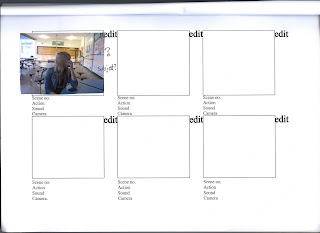
We quickly photographed a number of basic shots, including everything compulsory for the continuity task so it prpeared us for what was expected when we came to film the actual thing.
This allowed us to formulate some ideas, and have a deeper understanding of the brief.


Tuesday, 16 November 2010
TASK 9 - shared prezi's
http://prezi.com/presentation/kmarchese@yellow.esinet.org.uk/8iakay4/
Just testing out one of these joint prezi's...
This is a different form of prezi to what I had experienced before, it's one in which we can all acess and edit at the same time; whilst editing you see an 'avatar' of your other group members if they are also currently adding to the prezi. It's a much easier way of all contributing to a group task - we're all involved.
Subscribe to:
Posts (Atom)